


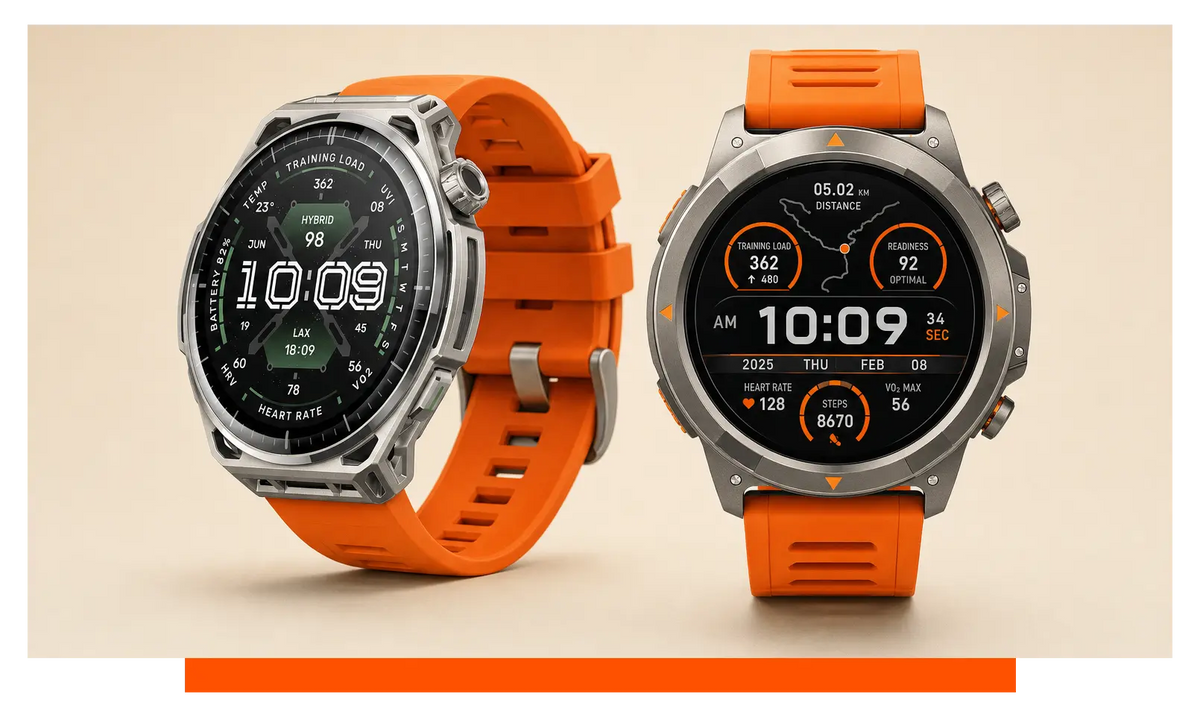
Comparison of the Amazfit Balance 3 and Balance Ultra
Choose the Amazfit Balance 3 for the better balance of training features, everyday comfort and value. The Amazfit Balance Ultra makes more sense when its longer GPS endurance and titanium-only build justify the higher price. The deciding factor is not HYROX support, which they share, but whether those hardware advantages outweigh a larger fit.
The short version
The Balance 3 is the sensible choice for most people because it retains the shared training platform while costing substantially less.
- Price: at the time of writing, the Amazfit Balance 3 was listed at £369.90, while the Amazfit Balance Ultra was £599.90.
- Battery: Balance Ultra reaches up to 30 days in typical use and up to 50 hours with GPS, compared with up to 21 days and up to 41 hours for Balance 3.
- HYROX: both watches have HYROX Race Mode and HYROX Simulations. HYROX support alone is therefore not a reason to pay more for Balance Ultra.
- Fit: both are large sports watches, but Balance 3 is slightly smaller and thinner. That distinction matters under a shirt cuff and when you wear the watch in bed.
- Build: Balance Ultra has a Grade 5 titanium case and an extra physical control. Balance 3 is offered in stainless steel or Grade 5 titanium.
- Core experience: the AMOLED display, sapphire glass, positioning system, health sensor, sports modes and Zepp OS platform are shared.
The deciding trade: Balance Ultra buys longer endurance and a titanium-only build, not a different core training system; Balance 3 keeps the stronger everyday-value argument.
Amazfit Balance 3 and Amazfit Balance Ultra specifications compared
The specifications show that battery endurance, case fit and price separate these watches far more clearly than their training or navigation features.
| Specification | Amazfit Balance 3 | Amazfit Balance Ultra |
|---|---|---|
| Price at the time of writing | £369.90 | £599.90 |
| Typical-use battery life | Up to 21 days | Up to 30 days |
| GPS battery endurance | Up to 41 hours | Up to 50 hours |
| Heavy-use battery life | Up to 10 days | Up to 15 days |
| Always-on display battery life | Up to 7 days | Up to 10 days |
| Case dimensions and weight | 51.4 x 51.4 x 14.6mm; 55g / 62g | 51.8 x 51.8 x 15.5mm; 57g |
| Case material | Stainless steel or Grade 5 titanium | Grade 5 titanium |
| Buttons | 4 | 5 |
| Included straps | 1 | 2 |
| HYROX tools | HYROX Race Mode; HYROX Simulations | HYROX Race Mode; HYROX Simulations |
| Display | 1.5" AMOLED | 1.5" AMOLED |
| Peak brightness | Up to 3,000 nits | Up to 3,000 nits |
| Display cover | Sapphire glass | Sapphire glass |
| Positioning | Dual-Band, 6 Satellite Systems | Dual-Band, 6 Satellite Systems |
| Water resistance | 10 ATM | 10 ATM |
| Diving support | 45m Freediving; Recreational Scuba Diving | 45m Freediving; Recreational Scuba Diving |
| Health sensor | BioTracker™ 6.0 PPG Biometric Sensor | BioTracker™ 6.0 PPG Biometric Sensor |
| Sports modes | 180+ | 180+ |
| Navigation | Contour Maps; Automatic Rerouting; Turn-by-Turn | Contour Maps; Automatic Rerouting; Turn-by-Turn |
| Platform | Zepp OS 6 | Zepp OS 6 |
The single meaningful trade is clear: you pay more for Balance Ultra’s extra endurance and titanium-only construction while receiving essentially the same display, positioning, health and training foundations.
Amazfit Balance 3 vs Balance Ultra: battery life
Balance Ultra is the better battery choice, especially if you record very long outdoor sessions or dislike charging during a busy training week.
In typical use, Balance Ultra is rated for up to 30 days, against up to 21 days for Balance 3. Heavy use brings those ratings down to up to 15 days and up to 10 days respectively. With the always-on display active, the figures are up to 10 days for Balance Ultra and up to 7 days for Balance 3.
The difference becomes most useful outdoors. Balance 3 can record for up to 41 hours with GPS enabled, while Balance Ultra extends that to up to 50 hours. Balance 3 already covers ordinary runs, rides, hikes and long day events comfortably; Balance Ultra gives you more room for an ultra-distance effort, a multi-stage outing or a route that lasts well beyond daylight.
Published battery ratings are best treated as ceilings because display use, navigation, sensor activity and notification volume all affect real-world endurance. The relative pattern is still helpful: Balance Ultra is consistently rated to last longer in every supplied battery scenario.
On your wrist, that means fewer charging decisions with Balance Ultra. If your outdoor sessions rarely test the Balance 3’s up to 41-hour GPS rating, however, battery life alone may not justify the premium.
Is the Amazfit Balance Ultra worth it if you do not race HYROX?
No - the Balance Ultra is not worth choosing specifically for HYROX because Balance 3 has the same stated HYROX Race Mode and HYROX Simulations.
This is an important correction to the idea that the more expensive watch necessarily has a separate HYROX experience. The supplied feature lists do not establish an Ultra-only training tool: both models include the named race and simulation functions.
If you do race HYROX, the decision still comes back to hardware. Balance Ultra’s longer battery life may suit someone combining frequent training with long outdoor sessions, while its extra physical control may be useful when sweaty hands make a touchscreen less convenient. Balance 3 delivers the same stated HYROX modes without asking you to accept the Ultra’s price.
If you do not race HYROX, ignore that badge entirely and judge the watches on fit, endurance and case material. In daily use, those are the differences you will actually encounter.
Size, weight and overnight comfort
Balance 3 has the slight comfort advantage because its case is smaller and thinner, although neither watch is designed to disappear on a small wrist.
Balance 3 measures 51.4 x 51.4 x 14.6mm, with listed weights of 55g / 62g. Balance Ultra measures 51.8 x 51.8 x 15.5mm and weighs 57g. The weight figures overlap in practice, so weight is not a clean win for either model; the clearer difference is that Balance 3 occupies a little less space and sits closer to the wrist.
That matters beyond sport. A thick watch can press against your hand during kettlebell work, catch on a fitted sleeve during a commute or feel more noticeable when your wrist is against a pillow. Strap tension also matters: wearing a large case too loosely allows it to move, while overtightening it can make overnight wear uncomfortable.
Balance Ultra remains a reasonable fit if you already enjoy substantial sports watches. If you are moving from a slim activity tracker or have a smaller wrist, trying the case size before committing is sensible. Readers comparing other large outdoor watches may also find our Amazfit T-Rex Ultra 2 vs Garmin Fenix 8 comparison useful.
What you will notice is not a dramatic weight gap but the Balance 3’s slightly less bulky profile during sleep, desk work and clothing changes.
Case materials and controls
Balance Ultra offers the more consistent premium build because every version uses Grade 5 titanium, while Balance 3 is available in stainless steel or Grade 5 titanium.
Titanium is attractive for a sports watch because it gives the case a premium feel without requiring the visual weight of a traditional polished steel watch. Balance 3 complicates the comparison in a good way: its titanium version means Balance Ultra does not hold an absolute material advantage, while the stainless-steel option gives Balance 3 a different finish at a lower starting price.
The control layout also differs. Balance 3 has 4 buttons and Balance Ultra has 5. A physical control is particularly useful with gloves, wet fingers or during a hard interval when precise touchscreen gestures become awkward. Whether the additional button changes your buying decision depends on how often you operate the watch while moving.
Neither model skimps on screen protection, as both place sapphire glass over the display. That shared cover matters if your watch regularly meets gym equipment, door frames or rocky paths.
In practice, Balance Ultra feels like the more specialised piece of sports hardware, while Balance 3 gives you a choice of case material and most of the same practical protection.
Straps, fit and everyday versatility
Both watches are unusually easy to adapt because they take 22mm quick-release straps, so the case does not have to dictate how the watch feels or where it looks appropriate.
Our catalogue fitment data confirms that Amazfit Balance 3 straps use a 22mm quick-release fitting. We stock compatible silicone, nylon, leather, milanese and metal options. The same is true for Amazfit Balance Ultra straps: 22mm, quick-release, with silicone, nylon, leather, milanese and metal choices in our range.
That shared fitting is more important than the box contents over the life of the watch. Balance 3 includes 1 strap and Balance Ultra includes 2, so the Ultra gives you more choice immediately. After that, either watch can be changed without replacing the case or learning a proprietary connector.
- Silicone is the practical option for sweaty training, rain and swimming because it is easy to rinse.
- Nylon can make either large case feel less rigid during long days and sleep.
- Leather helps the watch sit more naturally with office or formal clothing, but it is not the right material for wet training.
- Milanese and metal give the case a smarter appearance when exercise comfort is not the priority.
A strap cannot shrink the case, but it can stop a large watch feeling top-heavy. For most buyers, a flexible nylon or correctly sized silicone band will make a more noticeable comfort difference than the small gap between the watches’ listed weights.
Amazfit Balance 3 vs Balance Ultra: display
There is no meaningful display advantage either way because both watches use the same stated AMOLED size, brightness and cover material.
Each has a 1.5" AMOLED display capable of up to 3,000 nits, protected by sapphire glass. The high peak brightness is useful when you glance at pace or navigation instructions in direct sunlight, while AMOLED gives maps and data fields the contrast expected from a current sports watch.
Sapphire protection is also shared. You are therefore not paying for a stronger display cover when you move to Balance Ultra, nor sacrificing one by choosing Balance 3.
The always-on display does expose a battery difference: Balance 3 is rated for up to 7 days in that mode, compared with up to 10 days for Balance Ultra. If you want the screen continuously visible at work, the Ultra reduces charging frequency; if you are happy to wake it with a gesture, the core viewing experience remains equal.
Side by side, you would notice the case and battery behaviour before any difference in screen quality.
Amazfit Balance 3 vs Balance Ultra: GPS and navigation
GPS accuracy and navigation features are a draw on paper, while Balance Ultra’s advantage is how long it can keep recording.
Both watches use dual-band positioning across 6 satellite systems. Dual-band reception is valuable around tall buildings, tree cover and steep terrain because the watch has more positioning information available than a basic single-band setup.
The navigation package is also the same: contour maps, automatic rerouting and turn-by-turn directions. That makes either model suitable for following a planned run, ride or hiking route rather than merely recording where you went.
The distinction returns to endurance. Balance 3’s GPS rating is up to 41 hours; Balance Ultra raises it to up to 50 hours. If your events or expeditions approach those limits, Ultra offers the more useful margin. For routine training, both share the positioning hardware and navigation tools that shape the actual route experience.
On the move, route guidance should feel broadly alike; it is the later low-battery warning that Balance Ultra postpones.
Health and sports tracking
Health and sports tracking should not decide this comparison because both watches use the BioTracker™ 6.0 PPG Biometric Sensor and offer 180+ sports modes.
That shared sensor means neither model has an established generation advantage for optical biometric tracking. The broad sports list is shared too, as are the named HYROX modes. If your aim is to track regular runs, gym work, rides and recovery within the Balance system, Balance 3 provides the same stated foundation.
Fit can still affect the quality of your experience. A sensor works best when the watch remains stable rather than bouncing or sliding, so a correctly adjusted strap matters during intervals and uneven trail sessions. At night, comfort matters for a different reason: a watch cannot collect useful overnight data if you repeatedly take it off because the case or band feels intrusive.
What you are likely to feel is a difference in wearability, not a different generation of health hardware.
Water resistance and diving
Water resistance and diving support are equal, so neither watch earns the higher price through aquatic capability.
Both carry a 10 ATM water-resistance rating and support 45m freediving plus recreational scuba diving. Those are substantial shared credentials for swimmers and divers, and they make the watches much closer here than their names and prices suggest.
Your strap remains part of the decision. Silicone is the practical material for repeated immersion because it can be rinsed and dried easily. Leather should be changed before swimming, while metal and milanese bands may feel less comfortable when worn tightly enough to stop a large case moving in the water.
In the pool or at depth, you gain no stated capability by moving from Balance 3 to Balance Ultra.
Smartwatch software and everyday use
The everyday software experience is fundamentally shared because both models run Zepp OS 6.
That common platform supports the wider conclusion of this comparison: Balance Ultra is a hardware upgrade rather than a route into a separate software generation. Menus, training foundations and the general smartwatch environment come from the same operating system.
The physical interaction is where a small difference appears. Balance Ultra’s 5 buttons provide an extra control compared with the 4 on Balance 3. That may appeal if you prefer tactile operation during sport, though it does not alter the underlying platform.
For work, commuting and sleep, case fit and strap choice are likely to shape satisfaction more than Zepp OS, because the software does not create a meaningful split between these models.
Where Amazfit Balance 3 is better
Balance 3 is better where value, a marginally less bulky case and material choice matter most.
- Lower maker-listed price: £369.90 at the time of writing.
- Smaller case: 51.4 x 51.4 x 14.6mm, making it the less imposing option under sleeves and in bed.
- Case choice: stainless steel or Grade 5 titanium rather than a titanium-only range.
- Same core training basis: BioTracker™ 6.0, 180+ sports modes, HYROX Race Mode and HYROX Simulations.
- Same display specification: 1.5" AMOLED, up to 3,000 nits and sapphire glass.
- Same strap fit: 22mm quick-release, with broad material choice beyond the included band.
Where Amazfit Balance Ultra is better
Balance Ultra is better when endurance, titanium construction and more physical controls are worth paying for.
- Longer typical-use battery: up to 30 days rather than up to 21 days.
- Longer GPS endurance: up to 50 hours rather than up to 41 hours.
- Longer heavy-use battery: up to 15 days rather than up to 10 days.
- Longer always-on display battery: up to 10 days rather than up to 7 days.
- Titanium throughout the range: every listed case uses Grade 5 titanium.
- More physical controls: 5 buttons rather than 4.
- More in the box: 2 included straps rather than 1.
Who should choose which
Most buyers should choose Balance 3, while Balance Ultra suits a narrower group that will use its extra endurance and prefers its titanium-only construction.
- Choose Amazfit Balance 3 if you train several times a week and want the shared sports, navigation and health platform without paying the Ultra premium.
- Choose Amazfit Balance 3 if you have a smaller wrist and want the slightly smaller, thinner case, while accepting that it is still a substantial sports watch.
- Choose Amazfit Balance 3 if you wear one watch everywhere and value the freedom to change between silicone, nylon, leather, milanese and metal straps.
- Choose Amazfit Balance Ultra if you record very long outdoor sessions and can make practical use of up to 50 hours of GPS endurance.
- Choose Amazfit Balance Ultra if charging intervals matter most and its up to 30-day typical-use rating would simplify travel or a demanding training schedule.
- Choose Amazfit Balance Ultra if you want titanium as standard and prefer having 5 physical buttons plus 2 included straps.
The final call is simple: Balance 3 delivers the same core Balance experience with the stronger value and fit case; Balance Ultra earns its place only when longer endurance and its hardware treatment will genuinely change how you use the watch.
Frequently asked questions
These answers cover compatibility and training situations that sit alongside the main hardware comparison.
Do Amazfit Balance 3 and Balance Ultra work with both iPhone and Android?
Short answer: Yes. Both watches work with iPhone and Android phones through the Zepp app, so your phone platform does not decide between them.
Do either of these watches need a paid subscription?
Short answer: No. Neither Amazfit Balance 3 nor Balance Ultra requires a paid subscription, which is useful if you want to avoid an ongoing fee after buying the watch.
Do both sync workouts to Strava, TrainingPeaks and Apple Health?
Short answer: Yes. Both sync through the Zepp app with Strava, TrainingPeaks and Apple Health; Apple Health requires an iPhone, and third-party app availability can vary by region.
Can I pair a Stryd footpod with either watch?
Short answer: Yes. Both can pair with a Stryd footpod for real-time indoor pace during HYROX Race Mode, which is relevant if indoor running accuracy is part of your race preparation.
Are both watches suitable for pool swimming and open-water use?
Short answer: Yes. Both include Pool Swimming and Open Water Swimming modes alongside 10 ATM water resistance; use a silicone strap rather than leather or metal when you swim.


Leave a comment
All comments are moderated before being published.
This site is protected by hCaptcha and the hCaptcha Privacy Policy and Terms of Service apply.