


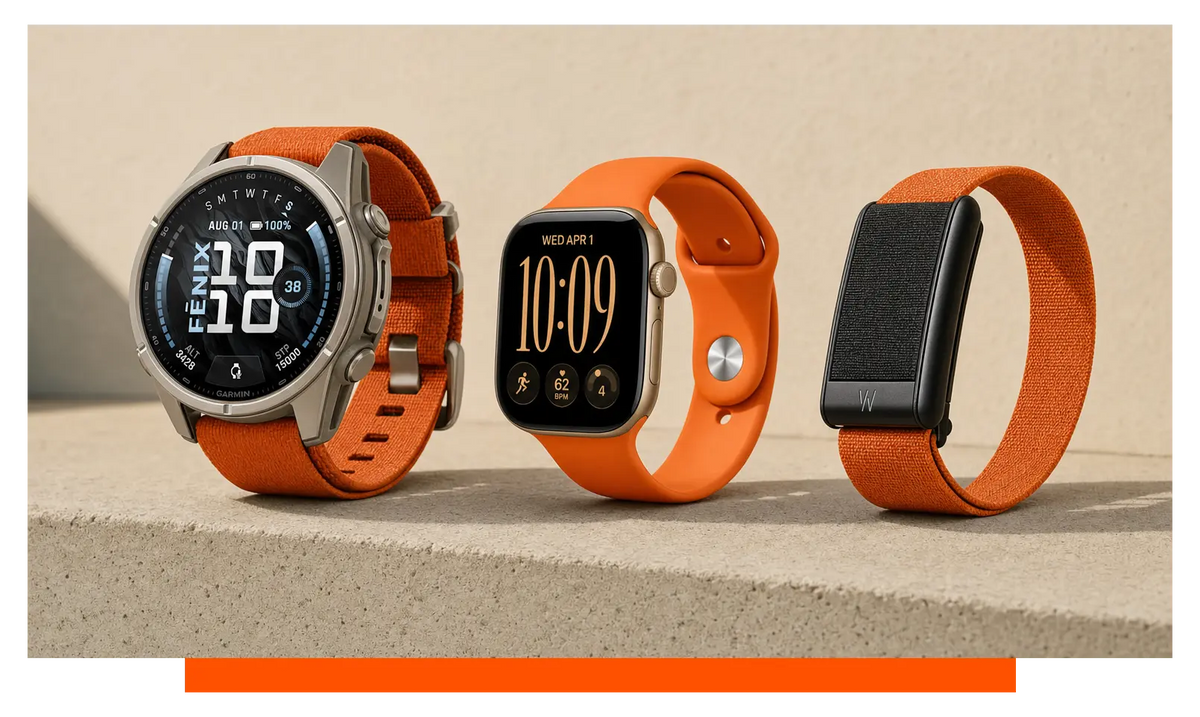
Garmin Fenix 9 is the best CrossFit smartwatch if you also run, hike or train outdoors, thanks to its long GPS workout battery, tough construction and data-rich recovery tools. Choose Apple Watch Series 12 for the easiest iPhone experience, or WHOOP 5.0 when recovery guidance matters more than seeing workout data mid-WOD.
On this page
Use these links to compare the watches, understand what affects wrist readings and find the model that fits your training.
- Best CrossFit smartwatches at a glance
- What makes a good CrossFit smartwatch?
- Best for iPhone users - Apple Watch Series 12
- Best overall for outdoor athletes - Garmin Fenix 9
- Best for endurance athletes - Coros Pace 4 Pro
- Best for health and fitness - Garmin Venu 4
- Best for recovery tracking - WHOOP 5.0
- How to choose a CrossFit smartwatch
- Frequently asked questions
Best CrossFit smartwatches at a glance
Garmin Fenix 9 is the strongest all-round choice here, but the right watch depends on whether you need information during the session or guidance after it.
| Smartwatch | Best for | Deciding spec | GPS workout battery life | Recovery coaching | Workout access |
|---|---|---|---|---|---|
| Apple Watch Series 12 | iPhone users | 24 hours | 10 hours | Readiness app | Workout app |
| Garmin Fenix 9 | Outdoor adventures | 64 GB | 30 hours | Training Readiness | Garmin Connect |
| Coros Pace 4 Pro | Endurance athletes | 60 hours | 60 hours | - | COROS App |
| Garmin Venu 4 | Health and fitness | 12 days | 15 hours / 20 hours | Training Readiness | Garmin Connect |
| WHOOP 5.0 | Recovery tracking | 14 days | No | Recovery | WHOOP app |
The deciding issue is whether you need dependable live workout data during mixed, high-grip sessions or mainly want recovery guidance between them.
What makes a good CrossFit smartwatch?
A good CrossFit smartwatch stays stable during rapid movement, presents useful information in the way you prefer and still suits the running or recovery work around your WODs.
Stable wrist heart-rate readings
Hard gripping, fast wrist movement and repeated forearm tension can disturb the optical signal used by wrist sensors. Resistance training is particularly difficult because the watch moves as your wrist flexes and blood flow around the forearm changes quickly.
No wrist watch can remove that problem entirely. A snug, stable strap keeps the sensor close to your skin and reduces movement between the case and your wrist. It should feel secure without pinching, and the case should sit away from the wrist crease where front-rack positions, kettlebells or gymnastic grips can press against it.
Strap choice is therefore part of measurement quality, not just appearance. Silicone handles sweat and is easy to clean, while a well-fitted nylon strap gives you fine control over tension. Leather, milanese and metal can work for everyday wear, but they are less practical for a sweaty WOD.
Live workout access
A screen matters if you check heart rate, elapsed time or workout progress between rounds. A screen-free tracker takes the opposite approach: it stays out of the way during training, then puts the useful analysis in its phone app.
Think about when you actually use the information. If seeing a live reading changes your pace, choose a watch with a clear workout display. If you rarely look at your wrist until the session is over, recovery analysis and wearing comfort may be more valuable.
Battery life beyond the box
Normal smartwatch battery and GPS workout battery answer different questions. Everyday battery determines how often the watch comes off for charging; GPS battery tells you whether it can cover outdoor runs, hikes and endurance events alongside CrossFit.
That distinction changes this shortlist. Indoor WODs do not demand hours of satellite tracking, but hybrid athletes may want one device for the gym and a long day outside. In that case, GPS workout life becomes far more important than it is for someone who trains only in a box.
Case comfort and overnight wear
A watch can collect excellent data and still be wrong for you if its case catches a wrist wrap or feels intrusive in the front rack. Lighter, lower-profile devices are generally easier to forget during burpees and overnight recovery tracking; larger outdoor watches trade some discretion for battery capacity and tougher materials.
Continuous wear matters most when sleep and recovery feed your training decisions. If a bulky case makes you remove the watch every night, its recovery features cannot give you the same consistent picture.
Best for iPhone users - Apple Watch Series 12
Apple Watch Series 12 is the easiest CrossFit choice for an iPhone user who wants a capable everyday smartwatch as well as a training companion.
The Workout app gives you an immediate on-wrist view, while the Readiness app helps connect training with recovery. Its GPS workout battery lasts 10 hours, which is ample for regular outdoor runs around your CrossFit schedule, though it is not the strongest option for very long endurance days.
- Smartwatch battery: 24 hours
- GPS workout battery: 10 hours
- Storage: 64GB capacity
- Workout platform: Workout app
- Recovery tool: Readiness app
Apple Watch Series 12 was listed at £369 at the time of writing.
Fit is easy to tailor because Apple Watch 12 straps are available in silicone, nylon, leather, milanese and metal. For CrossFit, silicone is the straightforward sweat-resistant option; nylon is useful when you want more precise tension during high-movement sessions.
Choose it if your watch also handles commuting, messages and daily health tracking. It is less compelling when your training regularly expands into long hikes or endurance sessions, where the Fenix and Coros offer substantially more GPS time.
Best overall for outdoor athletes - Garmin Fenix 9
Garmin Fenix 9 is the best overall CrossFit smartwatch for athletes who also run, hike or train outdoors and want one data-rich device for everything.
Its 30-hour GPS workout battery gives you far more room for outdoor endurance work than the Apple Watch Series 12 or Garmin Venu 4. Training Readiness provides the recovery context, while the AMOLED display keeps workout information visible on your wrist rather than sending you straight to a phone.
- GPS workout battery: 30 hours
- Smartwatch battery: 16 days
- Storage: 64 GB
- Weight range: 61g - 91g
- Construction: titanium bezel and sapphire lens
- Recovery tool: Training Readiness
At the time of writing, Garmin Fenix 9 pricing was £859 for the 43mm case, £899 for the 47mm case and £999 for the 51mm case.
Case choice matters in CrossFit. If wrist wraps or front-rack positions make larger watches uncomfortable, the smaller case is the sensible place to start; if outdoor battery and a substantial display matter more, compare the larger options in person.
There is useful flexibility after purchase. Silicone, nylon, leather, milanese and metal options are available among Garmin Fenix 9 43mm straps, Garmin Fenix 9 47mm straps and Garmin Fenix 9 51mm straps. A stable silicone or nylon fit makes the most sense in the box; another material can make the same watch feel less overtly sporty afterwards.
The compromise is bulk. Its weight varies considerably across the range, so an athlete with a small wrist or restrictive grips should not choose purely on battery life. Get the case fit right, though, and this is the most complete single-watch answer for mixed indoor and outdoor training.
Best for endurance athletes - Coros Pace 4 Pro
Coros Pace 4 Pro is the strongest pick for a CrossFit athlete whose schedule also includes long runs and endurance training.
Its 60-hour GPS workout battery is the longest in this comparison, yet the body weighs 43g. That combination is useful when you want endurance capability without carrying a much heavier outdoor watch through burpees, pull-ups and overnight wear.
- GPS workout battery: 60 hours
- Weight: 43g
- Dimensions: 47.6 x 47.6 x 11.8 mm
- Display: LTPO AMOLED Display
- Construction: Titanium Alloy and Sapphire Glass
- Workout platform: COROS App
Coros Pace 4 Pro was listed at £389 at the time of writing.
The case is broad, despite its low weight, so comfort around wrist wraps remains worth checking. Coros Pace 4 Pro straps are available in silicone, nylon, leather, milanese and metal, letting you use a stable gym-friendly material during training and a different finish between sessions.
Pick the Coros when GPS endurance is your overriding requirement. The supplied comparison does not establish an equivalent recovery-coaching feature, so athletes who put readiness guidance ahead of satellite battery have a clearer answer in Garmin or WHOOP.
Best for health and fitness - Garmin Venu 4
Garmin Venu 4 is the balanced choice for everyday health, gym work and outdoor exercise without the more substantial feel of the Fenix range.
It combines an AMOLED display, Training Readiness and Garmin Connect, so you can see information during a session and review the wider pattern afterwards. GPS workout battery is listed as 15 hours / 20 hours, while smartwatch battery is 10 days / 12 days.
- GPS workout battery: 15 hours / 20 hours
- Smartwatch battery: 10 days / 12 days
- Display: AMOLED
- Water resistance: 5 ATM
- Construction: stainless steel and polymer
- Recovery tool: Training Readiness
Both Garmin Venu 4 case sizes were listed at the same price at the time of writing: £469 for the 41mm model and £469 for the 45mm model.
That makes fit the more useful deciding factor. A smaller case is less likely to interfere with wrist flexion, while a larger face can be easier to glance at between rounds. Silicone, nylon, leather, milanese and metal are available for both Garmin Venu 4 41mm straps and Garmin Venu 4 45mm straps.
The Venu suits someone who wants Garmin recovery guidance but does not need the Fenix model’s tougher outdoor construction or the Coros model’s exceptionally long GPS life.
Best for recovery tracking - WHOOP 5.0
WHOOP 5.0 is the best CrossFit tracker when recovery, sleep and readiness matter more than seeing workout information on your wrist.
It records to the WHOOP app rather than presenting live data on a display. That is a genuine advantage if you find screens distracting, but a clear limitation if you use heart rate or elapsed workout information to change your pace during a WOD.
- Battery life: 14 days
- Weight: 26.5 grams
- Dimensions: 34.7 mm x 24 mm x 10.6 mm
- Display: No
- Built-in GPS: No
- Recovery tool: Recovery
WHOOP 5.0 was listed at £169 at the time of writing.
The light, compact body is well suited to continuous wear, including overnight. It is still important to keep the sensor stable during fast, high-grip movement, and replacement WHOOP 5.0 straps give you another route to restoring a secure fit when a worn band starts to move.
Choose WHOOP when the question you ask after training is “how well am I recovering?” rather than “what does my watch say right now?”. Anyone who needs built-in GPS or live wrist data should choose a screened watch instead.
How to choose a CrossFit smartwatch
Choose around the moment you use your data: during the WOD, during outdoor training or while deciding how hard to train next.
- If you use an iPhone and want an everyday smartwatch: choose Apple Watch Series 12 for straightforward workout recording, recovery context and close phone integration.
- If CrossFit sits alongside running, hiking and outdoor adventures: choose Garmin Fenix 9 for its combination of GPS battery, Training Readiness and tough materials.
- If long GPS sessions dominate your training: choose Coros Pace 4 Pro for its 60-hour GPS workout battery and 43g body.
- If you want a balanced health and fitness watch: choose Garmin Venu 4 for an AMOLED display, Training Readiness and a choice of case sizes.
- If recovery matters more than live workout data: choose WHOOP 5.0 for screen-free, continuous tracking and app-based guidance.
- If grips, wraps or front-rack work cause discomfort: prioritise the smallest comfortable case and a stable silicone or nylon strap rather than choosing on battery alone.
- If live heart-rate accuracy is critical during barbell or pull-up work: pair a compatible chest strap rather than expecting any optical wrist sensor to be perfect under forearm tension.
For most outdoor-minded CrossFit athletes, Garmin Fenix 9 remains the complete answer. Apple Watch Series 12 is easier to live with in an iPhone routine, while WHOOP 5.0 makes more sense when the useful information begins after the workout rather than during it.
Frequently asked questions
These answers cover the practical edge cases that often decide whether a CrossFit tracker works for you.
Should I use a chest strap for CrossFit instead of relying on wrist heart rate?
Yes, if live heart-rate accuracy matters during barbell, pull-up and high-grip work. Wrist readings can lag or miss rapid changes during resistance training, while Apple Watch can prioritise data from a paired third-party heart-rate monitor.
Is WHOOP useful for strength training if it has no screen?
Yes, if you are happy to review the session in the app rather than checking stats mid-WOD. WHOOP 5.0 tracks strength sessions, muscular load, heart rate, strain and recovery, but its screen-free design means there is no wrist display for live workout data.
Can I use an Apple Watch for CrossFit without an iPhone nearby?
Yes. Apple Watch Series 12 can record HIIT or Functional Strength Training and use its built-in GPS for an Outdoor Run without the paired iPhone nearby; workout data syncs when the watch reconnects.


Leave a comment
All comments are moderated before being published.
This site is protected by hCaptcha and the hCaptcha Privacy Policy and Terms of Service apply.