


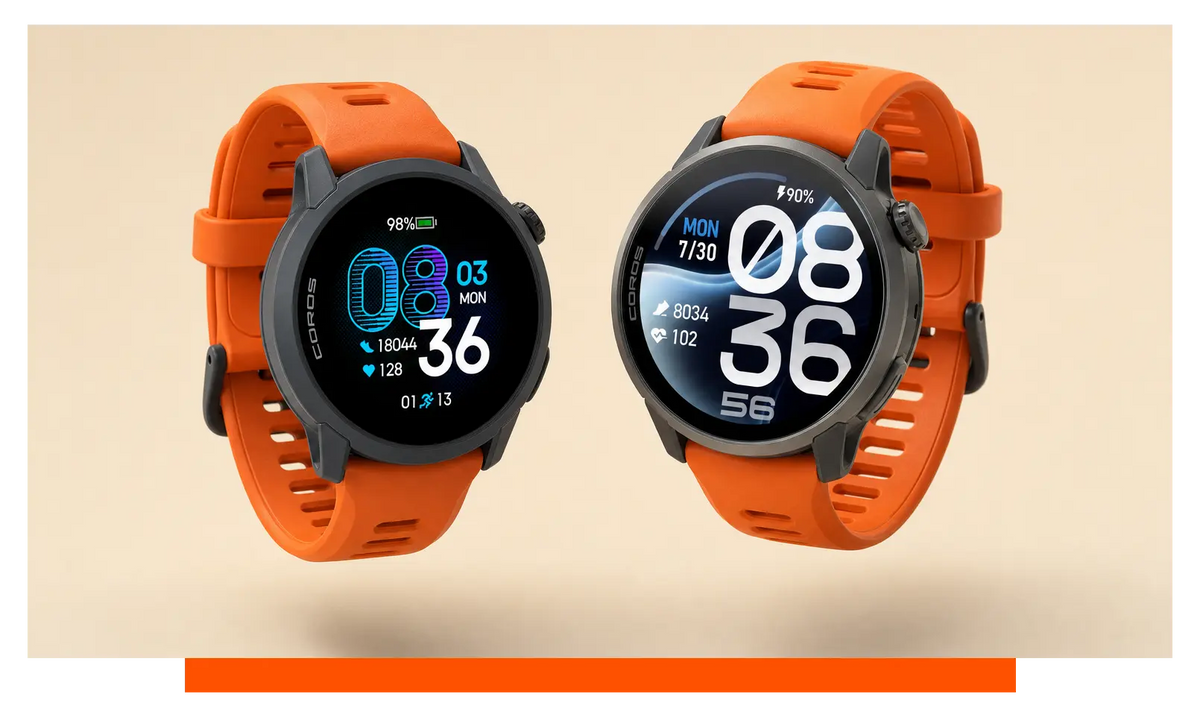
COROS Pace 4 is the smarter choice for runners who want a light, unobtrusive watch for training, sleep and everyday wear. COROS Pace 4 Pro earns its premium with a bigger, tougher display, better mapping and longer endurance, but only if its larger, heavier case remains comfortable on your wrist.
On this page
- The short version
- COROS Pace 4 vs Pace 4 Pro specifications compared
- Will Pace 4 Pro be comfortable on your wrist?
- Display size, brightness and durability
- COROS Pace 4 vs Pace 4 Pro: battery life
- Navigation and offline maps
- COROS Pace 4 vs Pace 4 Pro: GPS and outdoor training
- Health, sleep and everyday tracking
- Microphone, speaker and smartwatch hardware
- Storage for routes and audio
- Straps, sweat and all-day comfort
- Price and value
- Where COROS Pace 4 is better
- Where COROS Pace 4 Pro is better
- Who should choose which
- Frequently asked questions
The short version
The short answer is that Pace 4 covers the needs of most runners, cyclists and health-trackers without putting as much watch on your wrist.
- Choose COROS Pace 4 for comfort: its smaller case and lower on-wrist weight make it easier to forget during sleep, desk work and long runs.
- Choose COROS Pace 4 Pro for navigation: global offline maps and the larger display make unfamiliar routes easier to follow at a glance.
- The Pro lasts longer with GPS: it offers 60 hours against 41 hours for Pace 4, which matters most on extended adventures or training weekends without convenient charging.
- The Pro is built for harder treatment: sapphire glass and a titanium-alloy bezel offer a more protective combination than mineral glass and fibre-reinforced polymer.
- Pace 4 is the value pick: at the time of writing, COROS Pace 4 was £229.99, while COROS Pace 4 Pro was £389.
Wrist fit decides this comparison: the Pro’s screen, maps and endurance are worthwhile only when its more substantial case remains secure and comfortable all day and overnight.
COROS Pace 4 vs Pace 4 Pro specifications compared
COROS Pace 4 Pro leads on screen toughness, navigation and endurance, while Pace 4 packages the essentials into the lighter and less expensive watch.
| Specification | COROS Pace 4 | COROS Pace 4 Pro |
|---|---|---|
| Case dimensions | 43.4 × 43.4 × 11.8 mm | 47.6 × 47.6 × 11.8 mm |
| On-wrist weight with nylon band | 32 g | 43 g |
| Display size | 1.2-inch | 1.47-inch |
| Navigation experience | Offline maps (beta) | Global offline maps |
| GPS battery life | 41 hours | 60 hours |
| Price at the time of writing | £229.99 | £389 |
| Peak brightness | 1,500 nits | 3,500 nits |
| Display resolution | 390 × 390 pixels | 466 × 466 pixels |
| Display material | Mineral glass | Sapphire glass |
| Bezel material | Fibre-reinforced polymer | TC4 titanium alloy |
| Storage | 4 GB | 32 GB |
| Built-in speaker | No | Yes |
| Maximum GPS battery life | 31 hours | 40 hours |
| Daily-use battery life | 19 days | 21 days |
| Display type | AMOLED touchscreen | LTPO AMOLED touchscreen |
| Water rating | 5 ATM | 5 ATM |
| GPS technology | Dual-Frequency GNSS | Dual-frequency GPS |
| Microphone | Yes | Yes |
| Blood oxygen tracking | Yes | Yes |
| Barometric altimeter and sleep tracking | Yes | Yes |
Will Pace 4 Pro be comfortable on your wrist?
COROS Pace 4 Pro can be comfortable if you suit larger sports watches, but Pace 4 is the safer fit for smaller wrists, close sleeves and overnight wear.
Both cases have the same stated depth, so the difference is not about the Pro standing dramatically taller. Its footprint is the issue. Pace 4 measures 43.4 × 43.4 × 11.8 mm, whereas Pace 4 Pro measures 47.6 × 47.6 × 11.8 mm. That wider case occupies more of the wrist and is more likely to meet a sleeve cuff or extend towards the edges of a narrow wrist.
Weight strengthens the distinction. With their nylon bands, Pace 4 weighs 32 g on the wrist and Pace 4 Pro weighs 43 g. Neither is exceptionally cumbersome for a sports watch, but that difference repeats itself throughout the day: while typing, when your arm swings on a run and when the watch presses against bedding.
Stability also matters for tracking. A larger watch that shifts during sharp running movements or strength exercises can be less comfortable than a smaller case that stays planted without being overtightened. The Pro therefore works best when your wrist gives its wider body enough support. Tightening it excessively defeats the point.
If you already sleep happily in a substantial outdoor watch, the Pro’s dimensions need not rule it out. If you often remove watches at night, dislike cuffs catching around them or have found larger cases top-heavy, Pace 4 is much easier to recommend.
What you would notice: Pace 4 fades into the background more readily; Pace 4 Pro feels and looks like a more substantial piece of outdoor equipment.
Display size, brightness and durability
COROS Pace 4 Pro has the clearly superior display, combining a larger viewing area with stronger brightness and tougher materials.
The Pro’s 1.47-inch LTPO AMOLED touchscreen gives maps, data fields and menus more room than the 1.2-inch AMOLED touchscreen on Pace 4. Its 466 × 466-pixel resolution also exceeds the 390 × 390-pixel panel in the smaller watch. For route guidance, that extra space is genuinely useful: you can read the line and surrounding detail with less squinting while moving.
Peak brightness is another practical Pro advantage. Pace 4 reaches 1,500 nits, while Pace 4 Pro reaches 3,500 nits. Peak figures do not describe every lighting condition, but the higher ceiling gives the Pro more headroom when you glance down in fierce daylight.
The material difference may matter more than either number if you are hard on your kit. Pace 4 uses mineral glass surrounded by a fibre-reinforced polymer bezel. Pace 4 Pro pairs sapphire glass with a TC4 titanium-alloy bezel. That makes the Pro the more reassuring choice for rocky trails, busy gyms and everyday situations where your wrist meets door frames or equipment.
There is a catch, and it returns to fit. You receive that larger, tougher canvas only by accepting the wider and heavier watch. A display is not better for you if the case becomes annoying enough that you stop wearing it overnight.
In daily use: the Pro is easier to read outdoors and less worrying around hard surfaces, while Pace 4 keeps the screen adequate without dominating your wrist.
COROS Pace 4 vs Pace 4 Pro: battery life
COROS Pace 4 Pro lasts longer, but Pace 4 already has enough endurance for ordinary running, cycling and continuous health tracking.
The headline GPS figures are 41 hours for Pace 4 and 60 hours for Pace 4 Pro. COROS also lists maximum GPS battery figures of 31 hours and 40 hours respectively. Whichever listed GPS mode matches how you train, the direction is consistent: the Pro gives you a larger reserve.
That reserve pays off when your activity is long enough to make mid-session charging impossible, or when several GPS sessions fall close together. Ultra-distance events, extended open-water sessions, touring rides and weekends away from a charger all make the Pro easier to justify. It also provides more breathing room as the battery level falls.
For shorter regular sessions, the advantage is less decisive. A runner or cyclist who can charge between workouts is unlikely to reach the point where Pace 4’s GPS endurance blocks a session. Choosing the bigger case purely for battery can therefore be a poor trade if comfort matters every hour but the extra endurance matters only occasionally.
Daily-use battery life is closer: 19 days for Pace 4 and 21 days for Pace 4 Pro. Both reduce the charging friction that can leave gaps in sleep or wellness records. The Pro still wins, though not by enough to overturn an uncomfortable fit.
The practical difference: Pace 4 asks little of a typical training week; Pace 4 Pro is the watch you can trust for longer stretches of GPS use without planning a charge.
Navigation and offline maps
COROS Pace 4 Pro is the better navigation watch because global offline maps arrive on a larger, brighter screen.
Pace 4 offers offline maps in beta, so this is not a simple maps-versus-no-maps comparison. It can still suit runners and cyclists who mainly train on familiar roads, parks and trails, particularly when navigation is occasional rather than central to the activity.
The Pro’s global offline maps feel more at home on its 1.47-inch display. More screen area gives route lines and nearby context space to breathe, while the higher peak brightness helps when checking a turn outdoors. If you regularly explore unfamiliar trails or travel with routes loaded, this is the most persuasive reason to accept the bigger case.
Think about how often you genuinely look at a map on your wrist. Someone who follows known loops and uses navigation only as backup gains less from the Pro than someone making frequent decisions at junctions. Bigger is valuable here because it improves an action, not merely because the specification is higher.
Out on a route: Pace 4 provides useful guidance with less bulk; Pace 4 Pro makes unfamiliar navigation quicker to interpret without stopping as often.
COROS Pace 4 vs Pace 4 Pro: GPS and outdoor training
Both watches are serious outdoor-training tools, so the Pro’s advantage comes from endurance and presentation rather than Pace 4 lacking core GPS capability.
Pace 4 uses Dual-Frequency GNSS and Pace 4 Pro uses dual-frequency GPS. For a buyer, the important shared point is that both are designed to handle positioning in more demanding surroundings than a basic single-frequency sports watch. That is useful around tall buildings, wooded trails and routes with repeated bends.
Both also have a barometric altimeter. If you run or ride on hilly terrain, this supports elevation-aware training without forcing you into the larger model. Their shared 5 ATM water rating and dedicated swimming support make either watch viable for pool sessions and open-water tracking.
The Pro pulls away when an outdoor session combines navigation, harsh visibility and prolonged GPS recording. Its 60-hour GPS figure, larger map view and brighter display form a coherent package for long adventures. Pace 4 counters with a case that is less intrusive during faster runs and everyday recovery.
Do not overlook movement on the wrist. The most advanced outdoor package is not the best training choice if its case bounces or requires an uncomfortably tight band. Secure fit remains the foundation beneath the tracking features.
While training: both cover everyday running and cycling convincingly, but the Pro gives long-distance and route-led sessions more room to breathe.
Health, sleep and everyday tracking
COROS Pace 4 is generally the more wearable health tracker, because its lighter case is easier to keep on around the clock.
Both watches track blood oxygen and sleep, and both include a barometric altimeter alongside their sports features. That means the basic health-tracking decision is not about one watch recording sleep while the other does not. It is about which one you will actually keep on.
Sleep tracking is where case comfort becomes more important than the display advantage. A larger screen adds little while you are asleep, yet a wider, heavier case can be more noticeable against a pillow or under a duvet. Pace 4’s 32 g on-wrist weight with a nylon band gives it the natural advantage for continuous wear.
The Pro remains sensible if you are already comfortable sleeping in a large sports watch. Its 21-day daily-use battery also creates slightly more room between charges, helping you avoid removing it at the wrong time. Pace 4 reaches 19 days, however, so neither model demands frequent charging in normal daily use.
Consistency wins here. Health trends are more useful when your watch remains on for training, recovery and sleep, rather than spending nights on a bedside table because the case feels too prominent.
Over a full day and night: Pace 4 is easier to forget, while Pace 4 Pro trades some discretion for its larger visual and navigation tools.
Microphone, speaker and smartwatch hardware
COROS Pace 4 Pro has the more complete smartwatch hardware because it combines a microphone with a built-in speaker.
Both watches include a microphone, but only the Pro has the speaker listed in the specification grid. That distinction gives the larger model more scope for audible interaction and is useful if wrist-based calling is part of your routine.
Pace 4’s lack of a built-in speaker does not weaken its main purpose. It remains a training-first watch for people who want sports, route and health information without paying for every convenience available on the Pro. If your phone is normally close and you rarely interact with calls from your wrist, the missing speaker may not affect you.
Neither microphone nor speaker resolves the central choice for most runners. Those components are occasional conveniences; size and weight follow you through every workout and night of sleep. Treat the Pro’s speaker as a useful extra, not a reason to tolerate a poor fit.
What changes at the wrist: the Pro can handle more audible interaction, whereas Pace 4 keeps the hardware focused on quiet training and tracking.
Storage for routes and audio
COROS Pace 4 Pro offers far more storage, which better suits buyers who want to keep a larger offline library on the watch.
Pace 4 provides 4 GB, while Pace 4 Pro provides 32 GB. The Pro therefore gives maps, routes and stored audio much more breathing room, particularly if you prefer to prepare the watch once rather than manage its contents frequently.
Storage alone should not push a typical runner towards the heavier model. If you use familiar routes, carry a phone or maintain a modest offline selection, Pace 4’s capacity may never become the limiting factor. The larger allowance matters when your offline habits are genuinely extensive.
This is another area where the Pro’s features work together. Global offline maps, a larger display and more storage all support exploration. Pace 4’s smaller capacity sits with its simpler role: a light watch for training first, with navigation available when needed.
In practice: the Pro requires less pruning of offline content, while Pace 4 is sufficient when your saved library stays selective.
Straps, sweat and all-day comfort
The right strap can improve either watch, but it cannot completely disguise the Pro’s wider and heavier case.
Pace 4 uses 22 mm quick-release straps, giving you a clear fitment standard when replacing the original band. The available COROS Pace 4 straps include silicone, nylon, leather, Milanese and metal options. That range lets the same watch move from sweaty training to work or an evening out without changing the case.
Nylon is the strongest all-round choice for running and sleep. It is light, breathable and sweat-wicking, and its flexible adjustment can help you secure the sensors without creating a hard pressure point. That pairs especially well with the already light Pace 4.
Silicone makes more sense when easy cleaning is the priority. It can be rinsed and dried after a wet run, swim or gym session with little fuss. Leather, Milanese and metal options are better treated as changes in everyday style and feel rather than default choices for repeated sweaty workouts.
The same material categories are available among COROS Pace 4 Pro straps. A breathable nylon band can make the larger watch feel less cumbersome, while silicone gives it a practical wash-and-wear setup. Even so, the Pro remains 43 g with a nylon band and retains its 47.6 × 47.6 mm footprint.
Fit the band snugly enough to prevent sliding, but not so tightly that the case leaves persistent pressure during sleep or long sessions. If the Pro needs excessive tension to stay centred, Pace 4 is probably the better match for your wrist.
Once the band is changed: both watches can adapt to training and smarter settings, though Pace 4 preserves the greater comfort advantage for continuous wear.
Price and value
COROS Pace 4 offers better value for most runners, while Pace 4 Pro is worth its premium when maps, screen protection and long GPS sessions are regular needs.
At the time of writing, COROS Pace 4 was £229.99 and COROS Pace 4 Pro was £389. The higher price buys several connected upgrades rather than a cosmetic badge: global offline maps, the larger and brighter display, sapphire glass, a titanium-alloy bezel, more storage, a speaker and longer battery life.
That is a credible package. It is not automatically better value. If you mainly run familiar routes, cycle for manageable stretches and track sleep and health, Pace 4 already meets the brief while being easier to wear continuously. Money spent on Pro capabilities you rarely use cannot compensate for a case you notice every night.
The Pro becomes the sounder purchase when those upgrades solve recurring problems. If you often struggle to read maps on a small display, worry about scratching mineral glass or approach the limit of Pace 4’s GPS endurance, the premium has a clear purpose.
For your budget: Pace 4 spends less on features around the training experience; Pace 4 Pro charges more for a tougher, longer-lasting navigation package.
Where COROS Pace 4 is better
COROS Pace 4 is better when low weight, compact wear and price matter more than premium mapping hardware.
- Smaller on the wrist: its 43.4 × 43.4 × 11.8 mm case is easier to accommodate on narrower wrists and beneath sleeves.
- Lighter for continuous wear: 32 g with a nylon band makes it the stronger sleep and all-day option.
- Lower price: COROS Pace 4 was £229.99 at the time of writing.
- Plenty of GPS endurance for regular training: 41 hours covers most running and cycling plans without making you carry the Pro-sized case every day.
- Known replacement-band fitment: its 22 mm quick-release connection makes compatible strap sizing straightforward.
Where COROS Pace 4 Pro is better
COROS Pace 4 Pro is better for route-led adventures, rougher use and training that places greater demands on the battery.
- Longer GPS life: 60 hours gives extended sessions and trips more charging headroom.
- More useful maps: global offline maps are presented on a 1.47-inch display.
- Far brighter screen: 3,500 nits improves its visibility ceiling in strong outdoor light.
- Tougher outer materials: sapphire glass and a TC4 titanium-alloy bezel are reassuring around rocks, weights and everyday knocks.
- More offline capacity: 32 GB provides substantially more room for maps, routes and audio.
- More complete call hardware: both a microphone and built-in speaker are present.
Who should choose which
Most runners should choose Pace 4, while buyers who frequently navigate unfamiliar routes or need extended GPS endurance should choose Pace 4 Pro if it fits comfortably.
- Choose COROS Pace 4 if you have a smaller wrist and want a watch that sits more discreetly beneath clothing and during sleep.
- Choose COROS Pace 4 if you run and cycle on familiar routes and can charge between unusually long sessions.
- Choose COROS Pace 4 if health trends matter and low-friction overnight wear is more valuable than a larger map display.
- Choose COROS Pace 4 Pro if you regularly follow unfamiliar routes and want global offline maps on a bigger, brighter screen.
- Choose COROS Pace 4 Pro if your longest activities make charging inconvenient and its 60-hour GPS battery life would remove a real constraint.
- Choose COROS Pace 4 Pro if you are hard on your watch and value sapphire glass and a titanium-alloy bezel around trails, gyms or physical work.
Pace 4 is the easy all-day companion; Pace 4 Pro is the more capable adventure watch, provided your wrist is happy carrying the extra case.
Frequently asked questions
The main adjacent questions concern calls, payments, phone compatibility, ECG data and heart-rate accuracy during difficult movements.
Can COROS Pace 4 Pro make and take phone calls?
Yes. When connected to your phone by Bluetooth, COROS Pace 4 Pro can make and take hands-free calls through its built-in microphone and speaker.
Can I pay from either watch?
No. Neither COROS Pace 4 nor COROS Pace 4 Pro supports contactless payments, so you will still need another payment method when leaving your phone behind.
Do both work with iPhone and Android phones?
Yes. Both pair through the COROS app, which is available for iPhone and Android phones.
Do either watch offer ECG readings?
COROS Pace 4 Pro includes an ECG sensor for wellness data such as HRV, while Pace 4 uses its optical heart-rate sensor for these measurements instead. Neither watch is a medical diagnostic device.
Is the heart-rate tracking reliable for strength training and intervals?
It is generally dependable for steady exercise, but strength work and fast-changing intervals can cause occasional wrist-based errors. If precise targets matter, use a compatible chest strap or armband.


Leave a comment
All comments are moderated before being published.
This site is protected by hCaptcha and the hCaptcha Privacy Policy and Terms of Service apply.