


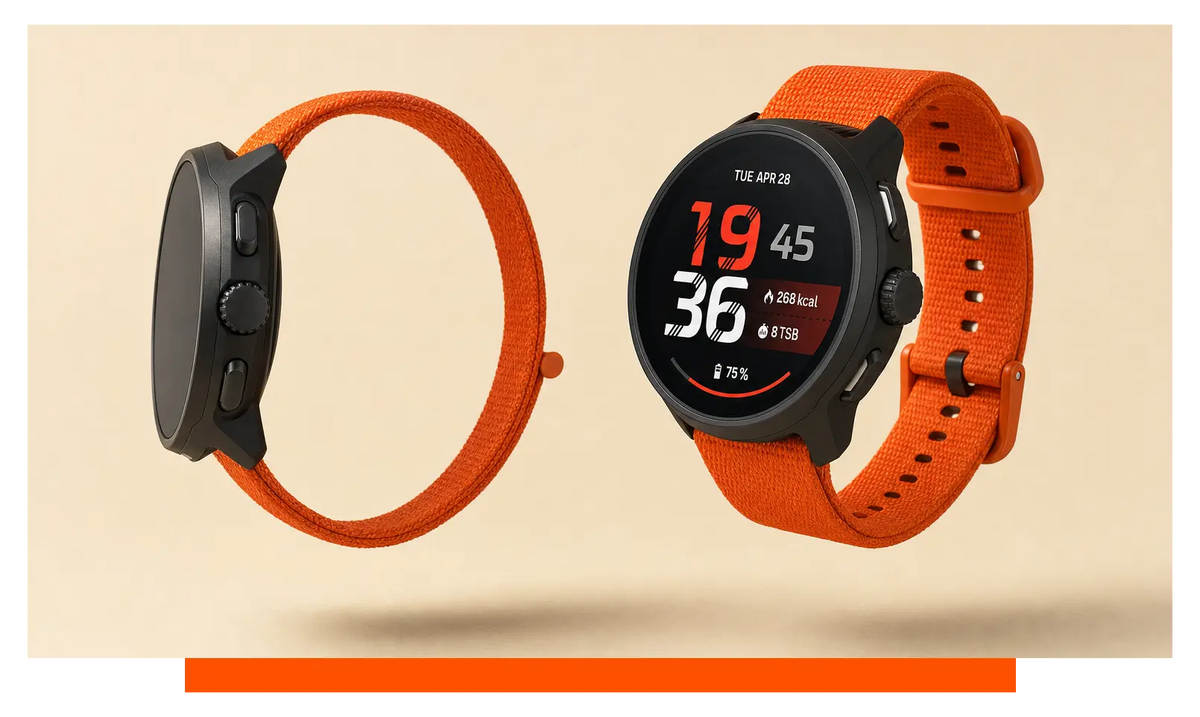
Upgrade to the Suunto Run 2 if you want offline maps and phone-free navigation for unfamiliar routes. Keep the Suunto Run if most of your running is on known ground: its familiar fit and core running experience remain compelling. The deciding factor is navigation, not the brighter screen or updated heart-rate sensor.
On this page
This comparison covers the differences that will change your experience while running, rather than treating every specification as equally important.
- The short version
- Suunto Run and Suunto Run 2 specifications compared
- Do Suunto Run 2’s offline maps justify the upgrade?
- Suunto Run vs Suunto Run 2: battery life
- Storage, music and podcasts
- Suunto Run vs Suunto Run 2: GPS support
- Heart-rate tracking
- Suunto Run vs Suunto Run 2: display
- Materials and controls
- Comfort, fit and strap compatibility
- Sleep and everyday tracking
- Price and upgrade value
- Where Suunto Run is better
- Where Suunto Run 2 is better
- Who should choose which
- Frequently asked questions
The short version
Suunto Run 2 is the meaningful upgrade for runners who want navigation, more audio space and a little more GPS endurance without carrying a phone.
- Choose Suunto Run 2 for unfamiliar routes: offline maps are its decisive advantage, particularly when you travel for races or regularly explore new trails and roads.
- Keep Suunto Run for familiar routes: it already has dual-frequency satellite support, offline music, an AMOLED touch display and the same power-saving GPS claim.
- Battery improves, but not in every mode: standard GPS life rises from up to 20 hours to up to 24 hours, while both watches claim up to 40 hours in power-saving GPS mode.
- Audio becomes more flexible: Suunto Run 2 supports music and podcasts and adds a much larger storage option; Suunto Run already covers offline music.
- The sensor updates are secondary: the brighter display and revised wrist heart-rate sensor may improve confidence and usability, but neither matters as much as whether you need maps.
Suunto Run and Suunto Run 2 specifications compared
The specification gap is concentrated around offline navigation, standard GPS endurance, storage, audio and the updated optical heart-rate sensor.
| Specification | Suunto Run | Suunto Run 2 |
|---|---|---|
| Offline maps | No | Yes |
| GPS battery life | Up to 20 hours | Up to 24 hours |
| Storage options | 4 GB | 4 GB / 64 GB |
| Music and podcast playback | Offline music | Music and podcasts |
| Wrist heart-rate sensor | Optical sensor | 12-channel optical sensor |
| Display brightness | 600 nits | 2,000 nits |
| Battery capacity | 295 mAh | 380 mAh |
| Price at the time of writing | £209.99 | £265 |
| GNSS frequency support | L1 + L5 | L1 + L5 |
| Satellite systems | GPS, GLONASS, Galileo, BeiDou, QZSS | GPS, GLONASS, Galileo, BeiDou, QZSS |
| Display resolution | 466 x 466 | 466 x 466 |
| Display type | AMOLED | AMOLED |
| Power-saving GPS battery life | Up to 40 hours | Up to 40 hours |
| Glass material | Gorilla Glass | Gorilla Glass |
| Bezel material | Stainless steel | Stainless steel |
| Touch display | Yes | Yes |
| Sleep tracking | Yes | Yes |
The trade that decides the upgrade is simple: Suunto Run 2 gives you offline maps, while Suunto Run does not.
Do Suunto Run 2’s offline maps justify the upgrade?
Yes, if you regularly run unfamiliar routes or travel for events; otherwise, offline maps are unlikely to justify replacing a Suunto Run that already serves you well.
This is the clearest functional split between the watches. Suunto Run 2 lets you retain navigation on the wrist when you head away from familiar roads or trails, so you do not have to depend on remembering every turn or keeping a phone readily accessible.
That changes real runs. A long route in a new city, a trail with several similar junctions or an event recce becomes easier to manage because the geographical context is on your watch. It is also useful when an intended turn is unavailable and you need to understand where the surrounding paths lead, rather than merely knowing that you have left a planned line.
The original Suunto Run remains the sensible watch for repeat loops, known club routes, track sessions and regular commutes. On those runs, you probably need pace, distance and training guidance more often than a map. Carrying a phone occasionally for a new route is also cheaper than replacing an otherwise satisfactory watch.
You would notice the upgrade most when standing at an unfamiliar junction. On your normal neighbourhood circuit, the distinction largely disappears.
Suunto Run vs Suunto Run 2: battery life
Suunto Run 2 lasts longer in standard GPS use, but the shared power-saving GPS claim means it is not a sweeping battery upgrade in every running mode.
Suunto Run is rated for up to 20 hours of GPS recording, while Suunto Run 2 reaches up to 24 hours. That extra margin is useful for long events, travel days involving several recorded activities, or runners who prefer not to charge immediately before every demanding session.
The physical battery also grows from 295 mAh to 380 mAh. Capacity alone does not tell you how long a watch will last because the brighter screen, sensors, satellite use and software all draw power, so the stated GPS running time is the more useful buying figure.
Both watches quote up to 40 hours in power-saving GPS mode. If that is already the mode you use for your longest days, Suunto Run 2 does not extend the published ceiling. Your decision comes back to navigation: a larger battery is more valuable when it is supporting maps on a route where you cannot easily recharge.
In practice, the difference you would feel is more breathing room in the standard GPS mode, not a transformation in maximum power-saving endurance.
Storage, music and podcasts
Suunto Run 2 is the stronger phone-free audio watch because it supports podcasts and offers a 64 GB storage option, while Suunto Run provides 4 GB and offline music.
For a regular playlist, the original watch may already do everything you need. You can leave your phone behind and still have music available, which removes one common reason to upgrade. If your listening habits are stable and you rotate only a modest selection of albums or mixes, more capacity may add little to the run itself.
Suunto Run 2 is more appealing if spoken audio accompanies long easy sessions, commutes or recovery runs. Podcast support saves you from treating every outing as a music-only choice, and the choice between 4 GB and 64 GB gives frequent travellers more room to keep audio on the watch.
Storage is therefore a supporting reason to upgrade rather than the main one. It becomes particularly persuasive when paired with offline maps: you can navigate and listen without making your phone part of the session.
What you would actually notice is less audio management before a run and more choice once you are outside.
Suunto Run vs Suunto Run 2: GPS support
The listed satellite support does not establish a major positioning advantage for Suunto Run 2 because both watches use L1 + L5 and support the same named satellite systems.
Each works with GPS, GLONASS, Galileo, BeiDou and QZSS. For a runner, dual-frequency support is the useful part: it is designed to give the watch more information in difficult surroundings such as built-up streets or areas where terrain and trees interfere with a clear view of the sky.
That does not mean every recorded route will be identical. Watch position, signal conditions and software processing can all affect a track, and the supplied specifications do not provide comparative accuracy results. It would therefore be a stretch to promise cleaner city corners simply because Suunto Run 2 is the newer watch.
If your Suunto Run already produces tracks you trust, GPS support alone is not a sound upgrade reason. If its readings are undermining your confidence, Suunto Run 2 may still be worth testing, but offline mapping remains the proven difference rather than a guaranteed accuracy leap.
On the wrist, both offer a similarly capable list of satellite connections; only the newer watch adds the map that helps you interpret where you are.
Heart-rate tracking
Suunto Run 2 has the more advanced listed wrist sensor, though that does not guarantee a meaningful improvement for every runner.
The original Suunto Run uses an optical sensor, while Suunto Run 2 specifies a 12-channel optical sensor. More channels can give the system more information to work with, but fit, skin contact, movement and wearing position still influence wrist readings. The watch needs to remain comfortably secure rather than sliding as your arm swings.
This update matters most if your current watch regularly produces readings that do not match your effort and those readings affect how you pace or review sessions. If your Suunto Run already gives stable trends for easy runs, harder efforts and recovery, replacing it solely for the sensor is a weaker value proposition.
The practical test is confidence. You may value the updated sensor if heart-rate uncertainty is interfering with training decisions, but it does not displace offline navigation as the clearest reason to move to Suunto Run 2.
Suunto Run vs Suunto Run 2: display
Suunto Run 2 should be much easier to read in strong daylight because its AMOLED display reaches 2,000 nits rather than 600 nits.
Both watches have a 466 x 466 resolution, an AMOLED panel and touch input. That means the upgrade is not about gaining a different basic screen format or a sharper stated resolution. It is about brightness.
That extra output is useful when you glance down briefly in direct sun, particularly during a fast effort when you do not want to hold your wrist at several angles. It should also help map visibility, making the brighter panel serve the navigation advantage rather than existing as an isolated specification.
Indoors, in shade or on evening runs, the original display may already be perfectly readable. Higher peak brightness is less important if you rarely struggle to see your current data screens.
You would feel this improvement through quicker glances on bright days, not through extra detail in the stated resolution.
Materials and controls
Neither watch has a clear materials advantage in the supplied specifications because both use Gorilla Glass, a stainless-steel bezel and a touch display.
That continuity is useful if you like the original Suunto Run’s balance of an everyday smartwatch face and sport-focused construction. Moving to Suunto Run 2 does not require accepting a completely different display material or bezel finish just to gain maps.
It also means the upgrade case should not be built around vague claims of greater toughness. No difference is established here. Gorilla Glass still needs sensible treatment, and a stainless-steel bezel can still pick up signs of regular use.
During an ordinary run, the interaction should remain familiar: you still have an AMOLED touch interface rather than a wholesale change in how the watch presents information.
Comfort, fit and strap compatibility
Suunto Run owners should not assume their current strap will move to Suunto Run 2, because only the original watch’s 22mm quick-release fitment is established in the supplied compatibility data.
That detail matters. A quick-release fitting makes it straightforward to change the original Suunto Run between a sweat-friendly training band and something more suited to work, but connector width and attachment design must match before any strap is transferred to another watch.
For the original model, available Suunto Run straps include silicone, nylon, leather, milanese, metal and titanium. That range gives the older watch a genuine flexibility advantage: silicone or nylon suits regular training, while leather, milanese, metal and titanium provide different looks and wrist feel away from sport.
Dedicated Suunto Run 2 straps are available in silicone, nylon, leather, milanese and metal.
Material can affect comfort more than the electronics. Silicone is practical around sweat and rain; nylon can feel softer and offers fine adjustment; leather and metal are better considered as everyday options when moisture management is not the priority.
The wrist-level conclusion is simple: the watch experience remains customisable, but confirm the connector before treating your existing strap collection as part of the upgrade value.
Sleep and everyday tracking
Sleep tracking is not a reason to choose between these watches because both models support it.
If you wear your watch overnight to connect rest with training, either model covers the stated core function. The more relevant issue is whether the watch and strap remain comfortable enough that you actually keep them on. A soft, accurately adjusted band can be more consequential overnight than a hardware update that does not change the listed sleep feature.
No broader health-tracking advantage is established by the supplied specifications, so it would be unwise to upgrade on an assumption that every wellness feature has changed. Suunto Run 2’s sensor is updated, but the proven buying differences remain maps, storage, audio flexibility, brightness and standard GPS endurance.
From evening to morning, you would retain the same headline sleep capability whichever watch you choose.
Price and upgrade value
Suunto Run offers better value for familiar-route runners, while Suunto Run 2 earns its premium when offline navigation will regularly replace phone use.
At the time of writing, Suunto Run was listed at £209.99 and Suunto Run 2 at £265. The newer watch costs more, so its extra features need to solve a real problem rather than merely look better in a comparison chart.
Maps are that problem-solver for travellers, trail explorers and runners who routinely create routes beyond their local area. The longer standard GPS claim, brighter display, podcast support and larger storage option then reinforce the decision.
If you run known roads and your current GPS and heart-rate data feel dependable, the original Suunto Run remains a very attractive alternative. Keeping it also preserves the value of compatible bands and avoids paying again for a core experience you already enjoy.
If your priorities are moving away from running and towards a more outdoor-led watch, the decision may involve a different range entirely; our Suunto Core 2 vs Suunto Core comparison covers that separate choice.
What you are paying for here is independence on unfamiliar routes. Without that need, the value case becomes much thinner.
Where Suunto Run is better
Suunto Run is better when value, established strap fitment and an already familiar running experience matter more than navigation.
- Lower price: Suunto Run was listed at £209.99 at the time of writing.
- Known strap standard: its 22mm quick-release fitment is established, which helps if you already own compatible bands.
- Enough audio for music-led runners: its 4 GB storage and offline music avoid taking a phone solely for a playlist.
- No satellite-system sacrifice: it shares L1 + L5 and the same listed satellite systems with Suunto Run 2.
- Same maximum power-saving GPS claim: both models reach up to 40 hours in that mode.
Where Suunto Run 2 is better
Suunto Run 2 is better for navigation, standard GPS endurance, bright conditions and runners who want more phone-free audio choice.
- Offline maps: you retain geographical context when running beyond routes you know.
- Longer standard GPS claim: up to 24 hours rather than up to 20 hours.
- More storage choice: 4 GB or 64 GB rather than a single 4 GB option.
- Broader audio support: music and podcasts rather than offline music alone.
- Brighter display: 2,000 nits rather than 600 nits, which matters most under direct sun.
- Updated wrist sensor: a 12-channel optical sensor replaces the original optical sensor specification.
Who should choose which
Choose according to where you run and whether you want the watch to replace your phone for navigation, not simply because Suunto Run 2 has the newer name.
- Choose Suunto Run if you mainly run familiar routes and its GPS tracks, heart-rate trends and offline music already meet your needs.
- Choose Suunto Run if value matters most and you would use phone-based navigation only occasionally.
- Keep Suunto Run if you have compatible straps you enjoy and maps would not change how often you train or where you go.
- Choose Suunto Run 2 if you travel for races or regularly explore routes where an on-wrist map reduces uncertainty.
- Choose Suunto Run 2 if you want to leave your phone behind while retaining navigation, music and podcast playback.
- Choose Suunto Run 2 if bright-screen readability or standard GPS endurance is a current frustration and those improvements accompany a genuine need for maps.
For known routes, keep the original; for confident phone-free running in unfamiliar places, Suunto Run 2 is the worthwhile upgrade.
Frequently asked questions
These answers cover adjacent Suunto Run 2 features that may affect training, swimming and the choice between current Suunto watches.
Does Suunto Run 2 support SuuntoPlus apps and guides?
No. Suunto Run 2 supports its own training modes and Suunto Coach plans, but it does not support SuuntoPlus sports apps or guides.
Can I build and follow structured workouts in the Suunto app?
Yes. If you train to planned sessions, you can create structured workouts in the Suunto app, sync them to Suunto Run 2 and follow them from your wrist.
Does Suunto Run 2 support Bluetooth headphones?
Yes. You can pair Bluetooth headphones to hear audio feedback during training or listen to music stored on Suunto Run 2.
Is Suunto Run 2 suitable for pool swimming as well as running?
Yes. It can record pool swims using the pool length you set, and it also includes an open-water swimming mode.
Do Suunto Run 2 offline maps require an ongoing subscription?
No. Suunto Run 2 includes free worldwide offline maps without an ongoing subscription.
Is Suunto Run 2 a better buy than Suunto Race S?
Not for everyone. Choose Suunto Run 2 for a lighter running watch with offline music and 4 GB or 64 GB storage; choose Suunto Race S when SuuntoPlus sports apps and guides, 32 GB map storage and longer battery options matter more.


Leave a comment
All comments are moderated before being published.
This site is protected by hCaptcha and the hCaptcha Privacy Policy and Terms of Service apply.